You've heard the stories about AI engineers being impossible to find.
Data scientists commanding $166K before they've unpacked their laptops.
Cloud architects fielding five offers before updating their LinkedIn.
Hardware engineering is harder. And nobody's talking about it.
While the tech recruiting world obsesses over software roles,
a quiet crisis is building on the hardware side — and growing
companies with product roadmaps that depend on it are starting
to feel the pain.
HERE'S WHAT THE DATA SAYS
According to the US Bureau of Labor Statistics, engineering
occupations are projected to grow 13% by 2031. That sounds
manageable until you add the other side of the equation.
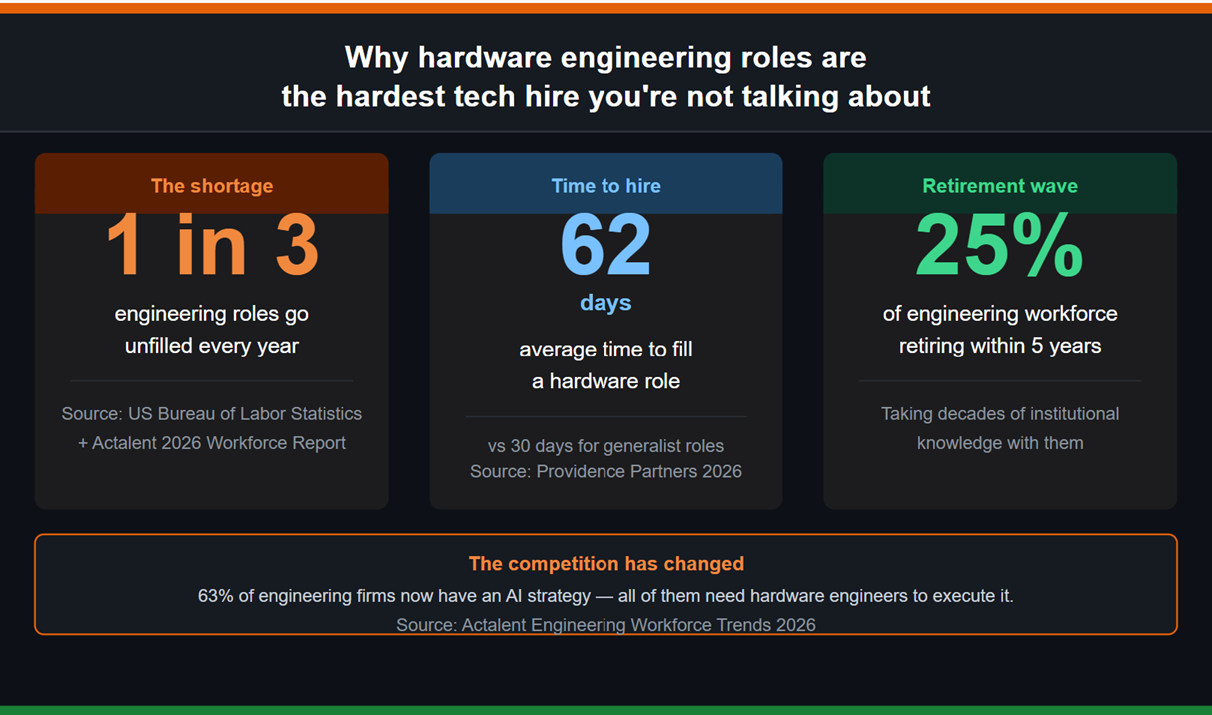
One in three engineering roles goes unfilled every year.
The average engineering hire takes 58 to 62 days — and that's
for companies that know what they're looking for. Many don't.
And here's the structural problem that doesn't get enough
attention: approximately 25% of the current engineering
workforce plans to retire within the next five years.
These aren't just headcount vacancies. When a 30-year
veteran hardware engineer walks out the door, they take
decades of institutional knowledge with them. PCB layout
instincts. Signal integrity intuitions. Systems integration
experience that cannot be taught in a classroom.
You cannot replace that overnight.
WHAT MAKES HARDWARE DIFFERENT FROM SOFTWARE
Software engineering has a global talent pool. If you can't
find a Python developer in New York you can find one in
Austin, London or remotely anywhere in the world.
Hardware doesn't work that way.
Roles requiring physical lab access, prototype iteration,
manufacturing floor presence or security clearance are
location-bound. You can't design a PCB from a coffee shop.
You can't validate an RF circuit over Zoom.
This geographic constraint narrows the available talent
pool dramatically — especially for companies outside
the major tech hubs.
The most in-demand hardware specializations right now:
— PCB designers and layout engineers
— Embedded systems engineers
— Electrical engineers with RF or power experience
— FPGA developers
— Hardware security specialists
— Systems integration engineers
— Semiconductor and chip design engineers
Each of these is a niche within a niche. And the candidates
who have deep experience in them are not sitting on job boards
refreshing their inboxes.
THE AI EFFECT ON HARDWARE HIRING
Here's a wrinkle that most hiring managers don't see coming.
The AI buildout is a hardware problem as much as a software one.
Every large language model needs chips to run on. Every data
center needs power infrastructure. Every AI-enabled product
needs sensors, processors and embedded systems.
According to Actalent's 2026 engineering workforce research,
63% of engineering firms are already building or have an
AI strategy in place — and they all need hardware engineers
to execute it.
This means hardware engineering talent is now competing
for the same budget as AI software talent. The companies
writing the biggest checks for engineering talent are no
longer just the defense primes and chip manufacturers.
They're the hyperscalers, the AI hardware startups and
the EV manufacturers.
The talent pool didn't get bigger. The competition for it did.
WHAT ACTUALLY WORKS WHEN HIRING HARDWARE ENGINEERS
After two decades of placing technical talent at growth-stage
companies, here's what we see working right now:
Stop writing job descriptions that describe a unicorn.
A job posting asking for PCB layout experience, FPGA development,
embedded C expertise AND systems architecture ownership is
describing four different people. Get specific about the
single hardest problem you need solved.
Move faster than your process allows.
The best hardware candidates receive multiple offers within
weeks. If your interview process takes eight rounds over
six weeks you will lose every candidate worth having.
Addison Group's 2026 engineering workforce data confirms
there are currently three engineering jobs for every one
qualified candidate. They are choosing who to talk to —
not the other way around.
Look beyond the resume.
Hardware engineers build things. The best ones have
GitHub repos, personal projects, conference presentations
or patents. A portfolio tells you more than a degree.
Be honest about location.
If the role requires on-site presence say so clearly and
early. Candidates who discover this surprise late in the
process will exit — and you'll have wasted weeks of
recruiting cycles.
WHERE 4 STAFFING CORP COMES IN
We've been placing hardware and electrical engineering
talent at growing technology companies for 20 years.
We know where the PCB designers are.
We know which embedded engineers are quietly open to a move.
And we know how to have the conversation that gets a
passive candidate to take your call.
If you have a hardware engineering role that's been open
for more than 60 days — or if you know one is coming
and want to get ahead of it — let's talk before the
timeline becomes urgent.
No hire. No fee. Nothing to lose.
→ Free consultation:
4staffing.net/index.php/contact
Sources:
— US Bureau of Labor Statistics Occupational Outlook 2024
— Addison Group 2026 Engineering Hiring Trends Report
— Actalent Engineering Workforce Trends 2026
— Providence Partners Engineering Talent Shortage 2026