The data is unambiguous.
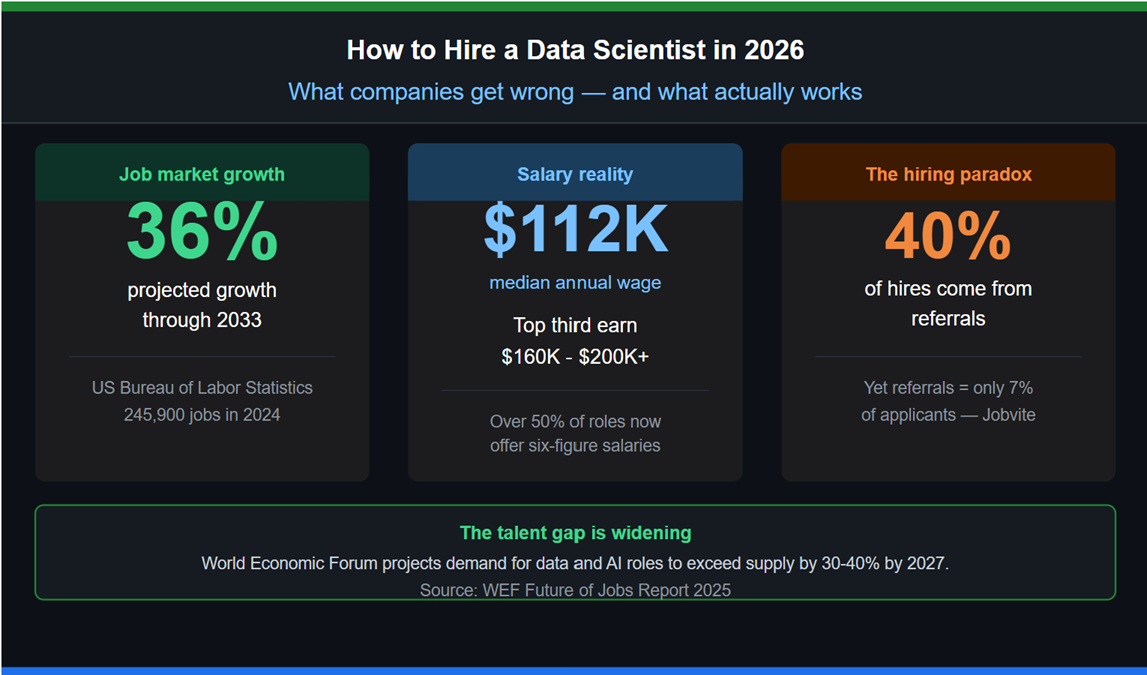
Data science roles are projected to grow 36% through 2033
according to the US Bureau of Labor Statistics. The World
Economic Forum projects demand for data and AI roles will
exceed supply by 30 to 40 percent by 2027. Over half of
data science jobs now offer six-figure salaries.
And yet hiring managers are struggling to fill these roles.
Candidates are sending out 400 applications and hearing
nothing back. Something is broken — and it is not the
talent pool.
The problem is almost always on the hiring side.
THE THREE MISTAKES COMPANIES MAKE
Mistake 1 — Writing the wrong job description.
The most common error we see is a job description that
describes a data scientist when the company actually needs
a strong analyst. As one practitioner with a decade in
the field put it bluntly: most companies do not need a
data scientist. They need someone who can write SQL,
build dashboards, and tell a coherent story with data.
Those are two very different profiles with very different
compensation expectations and very different interview
processes. Confusing them wastes everyone's time and
produces a hire that either leaves within a year because
they're bored or underperforms because they were hired
for depth they don't need.
Before writing a single line of the job description ask
this question: do we need someone to build and deploy
machine learning models or do we need someone to surface
business insights from our existing data? The answer
determines everything that follows.
Mistake 2 — Evaluating for skills that don't matter on the job.
Technical screening in data science hiring has gotten
out of hand. Candidates are being tested on AWS
architecture, Docker configurations, and obscure
algorithm implementations that rarely if ever come up
in real work.
Meanwhile the skills that actually determine whether
a data scientist succeeds — statistical reasoning,
business problem framing, model interpretability,
and the ability to communicate findings to non-technical
stakeholders — often get five minutes at the end of
a six-hour interview loop.
The practical test is simple. Look at what your last
data science hire spent their time on in their first
90 days. Were they deploying containers or were they
cleaning data, building dashboards, and explaining
their findings in business reviews? Screen for the
latter.
Mistake 3 — Moving too slowly.
The data science talent shortage is driving salaries
upward. As of 2025, over half of data science jobs offered
six-figure salaries, with about one-third paying between
$160,000 and $200,000 annually. These are not candidates
who are waiting by the phone.
The best data scientists — the ones with proven business
impact, clean portfolios and real deployment experience —
are fielding multiple conversations simultaneously. A
hiring process that drags past six to eight weeks is
not just slow. It is a candidate filter that
systematically eliminates the best people and leaves
you choosing from whoever had the patience to wait.
WHAT ACTUALLY WORKS IN 2026
The companies that hire well in this market do a few
things differently.
They start with the business problem not the title.
Instead of "we need a senior data scientist" they
start with "we need to reduce customer churn by 15%
and we don't know which customers are at risk." That
specificity attracts candidates who can solve that
problem and filters out everyone else.
They look for proof of work not just credentials.
A 4.0 GPA from a top program is a signal. A GitHub
repository showing a gradient boosting model that
achieved 97.9% AUC on real healthcare data is a
proof point. The best data scientists at every career
stage have built things and can show them to you.
Look for the portfolio.
They move fast when they find the right candidate.
The referral stat tells the real story here. According
to Jobvite, employee referrals make up just 7 percent
of applicants but yield 40 percent of hires — because
referred candidates move through the process faster
with a human connection already established. If you
are relying entirely on cold job board applications
you are fishing in the hardest pond.
They understand the AI layer has changed the bar.
In 2021 a strong data scientist needed Python, SQL,
and machine learning fundamentals. In 2026 those are
table stakes. The new bar adds AI fluency — the
ability to prompt effectively, validate AI-generated
code, and know when a model is confidently wrong.
Candidates who have integrated these skills into their
workflow are running circles around those who haven't.
WHERE 4 STAFFING CORP COMES IN
We specialize in placing data science and analytics
talent at growing technology companies. We know the
difference between a candidate who can pass a
technical screen and one who can actually move the
needle on your business problem in the first 90 days.
And because the best data scientists are not refreshing
job boards, we find them where they are — in their
current roles, quietly open to the right opportunity.
No hire. No fee. Nothing to lose.
Free consultation:
4staffing.net/index.php/contact
Learn more about our Data Science and Analytics recruiting practice:
4staffing.net/index.php/our-specialties/82-data-science-analytics-recruiting
Sources:
- US Bureau of Labor Statistics Occupational Outlook 2024
- World Economic Forum Future of Jobs Report 2025
- Jobvite Recruiting Benchmark Report 2025
- Refonte Learning Data Science Trends 2026
- Bureau of Labor Statistics median wage data May 2024